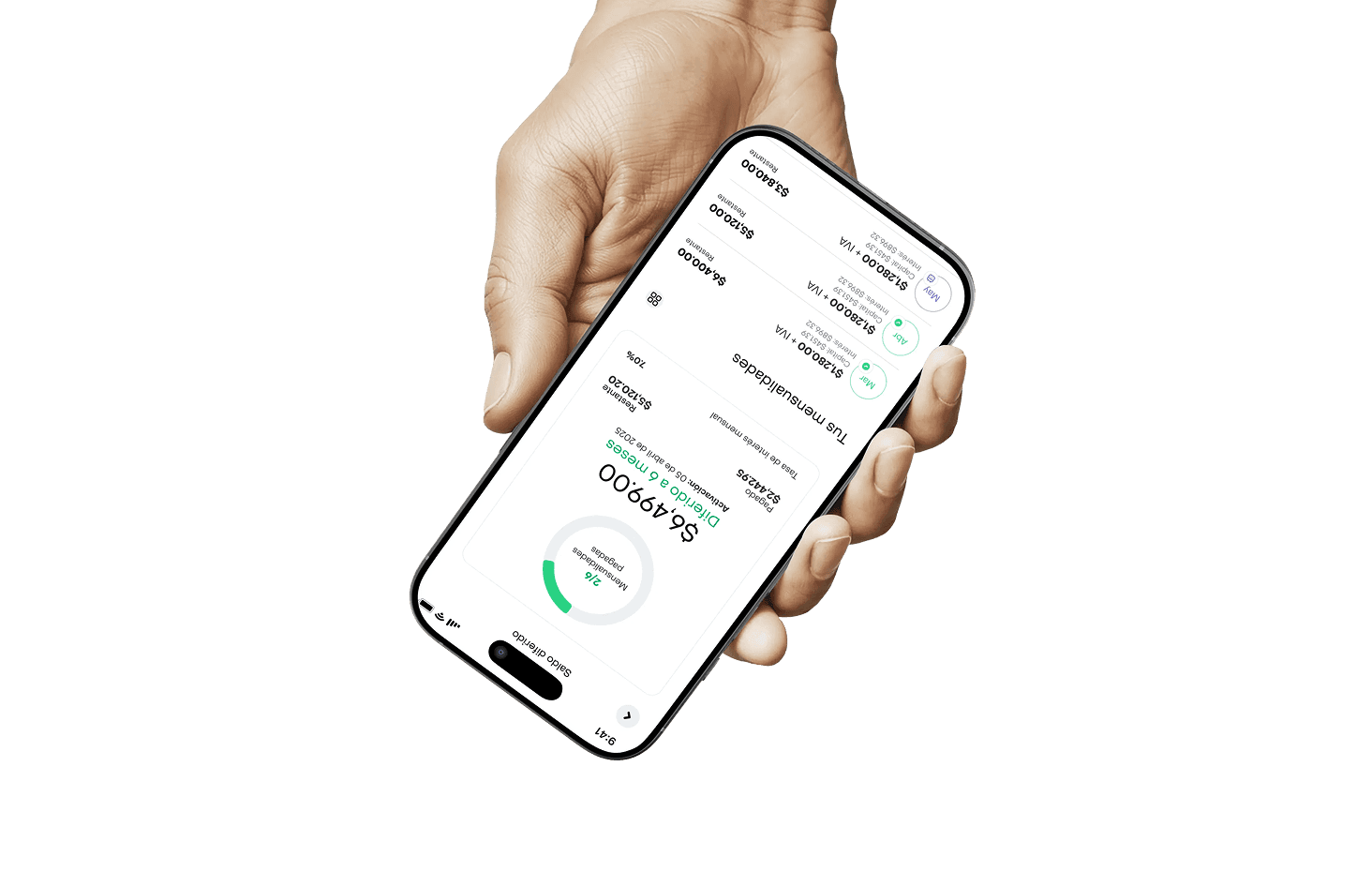
Redesigning the payment plan detail experience for RappiCard’s Deferred Balance product, aiming to improve how users understand and track their month-by-month breakdown.
Key Takeaways
Clarity in financial products depends more on visual hierarchy than on the amount of data shown.
Users often don’t need the full amortization detail — a strong summary can support decision-making better.
Payment tables should evolve from technical lists into interpretable progress systems.
Progress visualization (paid vs pending) increases emotional control and reduces uncertainty.
Design Process




Final solution
Full redesign of the
Deferred Balance payment
plan detail module
Central integration
of progress visualization
Evolution from a technical
amortization table into a
clearer tracking experience
Scalable system
for multiple term lengths
(3, 6, 12 months)
Improved usability and
clarity for debt management
products
Impacted metrics
User confusion

Reduced
Around Deffered Debt pending payments plans
Customer contact
Reduced
Lower customer support contact related to plan tracking
Engagement

Increased
With debt management tools, increasing trust and confidence
Learning &
growth
This case strengthened my ability to translate usability insights into actionable UI improvements within a credit product context.
Learned that in financial experiences, the challenge is not only providing accurate information, but structuring it in a way that reduces cognitive load and builds user confidence.
It was also a valuable exercise in balancing information density with simplicity, iterating from early explorations to a scalable final solution.