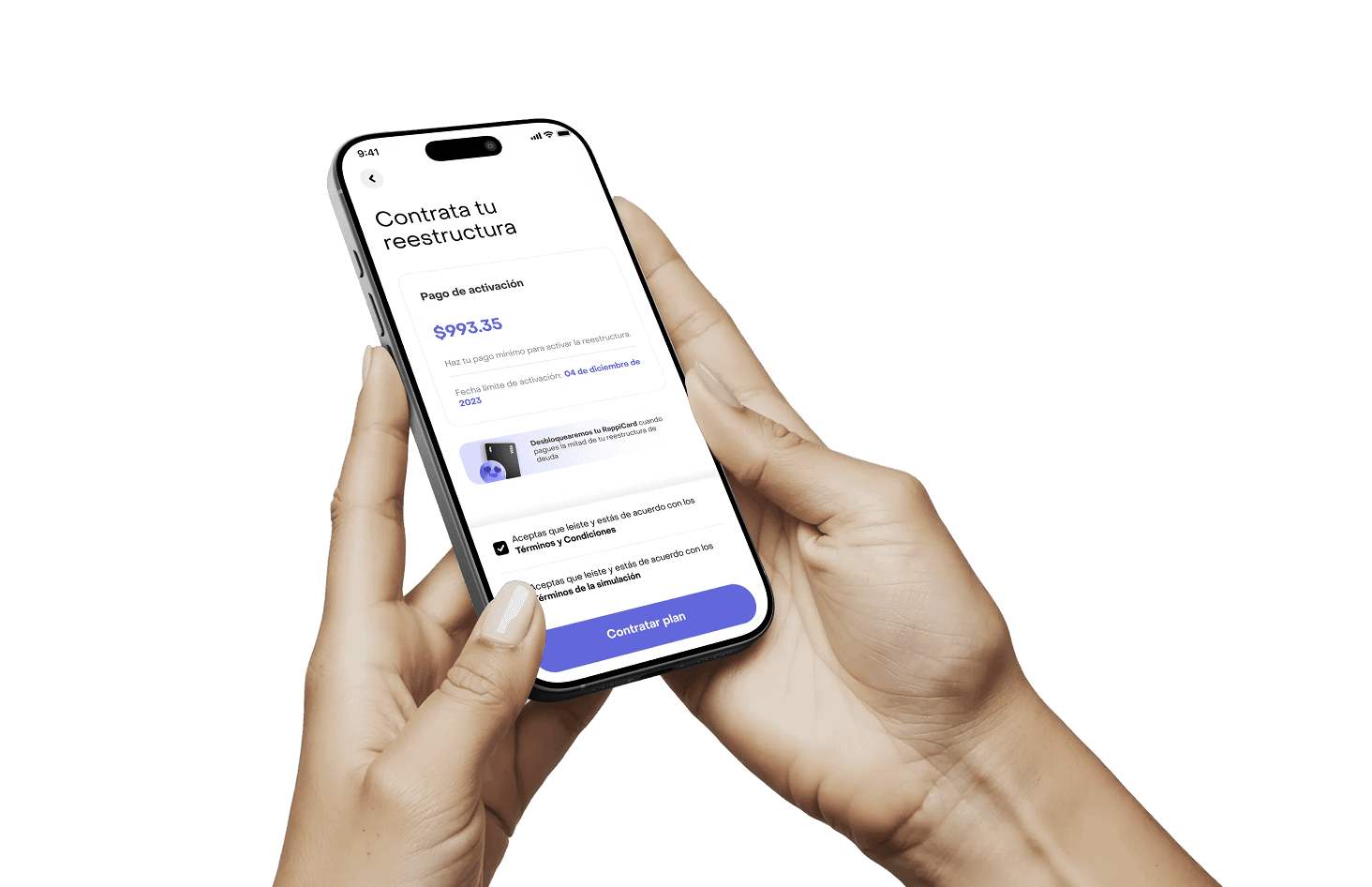
Experience to help users regain control of revolving credit balances before and after delinquency. The solution combined a reactive restructuring flow for users already in financial difficulty, and a preventive relief plan for users showing early risk signals.
Key Takeaways
Debt support is most effective when offered before users fully default.
Financial clarity and transparency are essential in high-stress decision moments.
Preventive intervention can outperform reactive recovery in both user trust and portfolio outcomes.
Designing for financial hardship requires balancing empathy with strong risk controls.
Self-service restructuring reduces operational costs while improving scalability.
Final solution
Activation payments
work as both trust and risk control
Users commit faster
when repayment options
are transparent
Preventive intervention
reduces delinquency
escalation
Progressive guidance
lowers decision fatigue
Relief is framed as
support, not punishment
Impacted metrics
Cost to serve

Reduced
vs Manual call-center contact restructuring
Risk control

Improved
Higher early and late control recovery of users
Finantial trust

Increased
Improved perceived financial control and trust by self serve
Learning &
growth
I learned that debt relief products are not just transactional flows — they are trust systems.
By evolving restructuring from reactive recovery into preventive support, we demonstrated how fintech can build experiences that protect both:
The user’s financial wellbeing
The business portfolio health