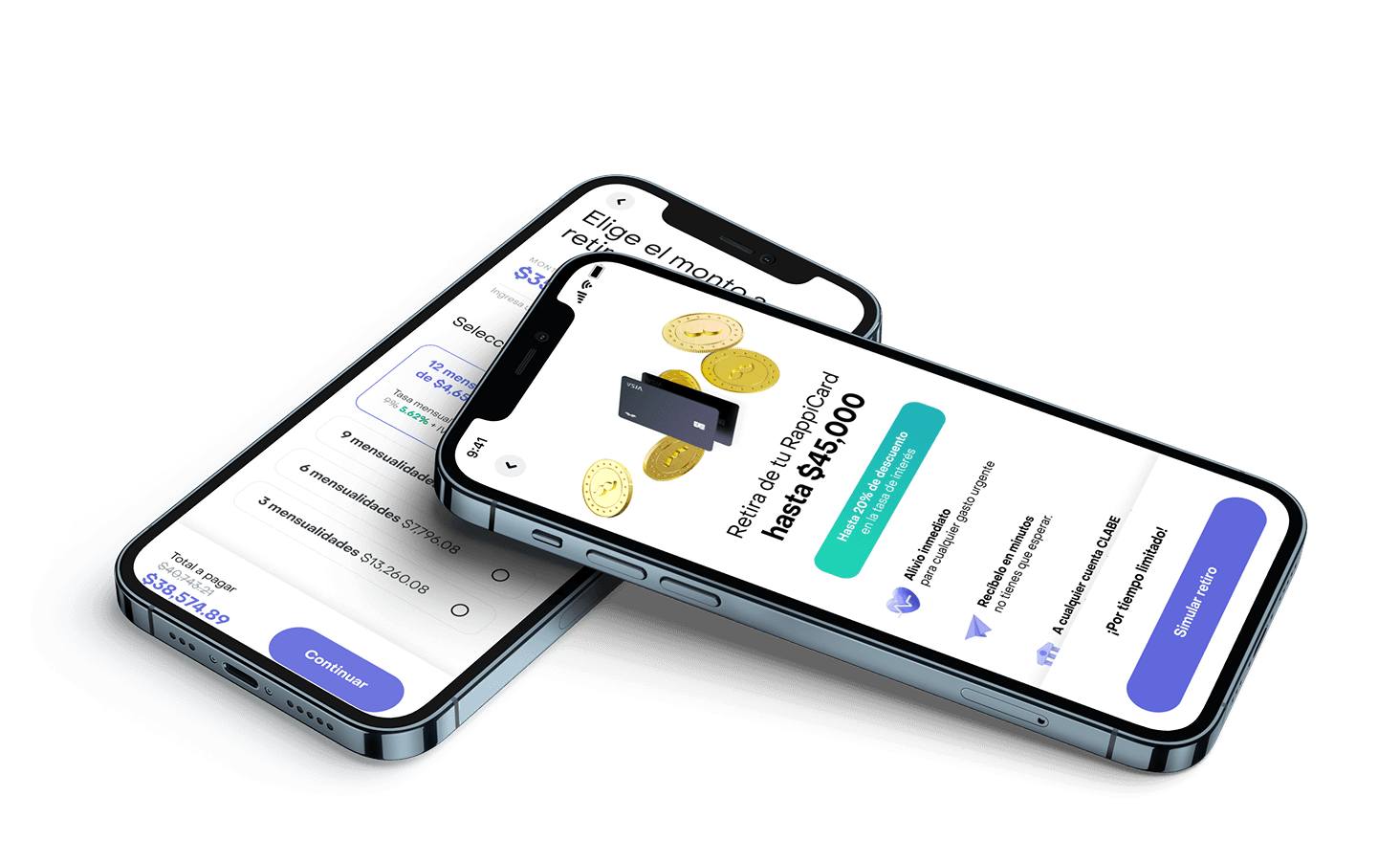
Is one of RappiCard’s most critical lending products, primarily used in emergency scenarios where users need immediate liquidity. Despite strong product–market fit and a differentiated value proposition (instant transfer to external CLABE accounts),
Key Takeaways
Users choose card advance primarily as an emergency solution; speed and certainty outweigh exploration.
Financial decisions are delayed or abandoned when critical information (rate, monthly payment, total cost) is revealed too late.
Precision beats interaction: text inputs and explicit options outperform sliders for high-stakes decisions.
Urgency is effective when grounded in real constraints (offer validity, rate discounts), not artificial pressure.
Design Process




Final solution
Dynamic novelty
banner with countdown timers
adapted to billing cycles.
Editable amount input
replacing sliders for higher
precision and confidence.
Progressive and anticipatory
disclosure of rate, discount, monthly payment, and total cost.
Clear prioritization of
information: amount → monthly payment
→ rate → total payable.
Fixed primary CTA to
reduce friction and hesitation.
Impacted metrics
Conversion rate

Increased
End-to-end conversion rate of the cash withdrawal flow.
Novelty CTR
Increased
Click-through rate (CTR) on the novelty banner.
Average withdrawn
Increased
Average withdrawn amount per user (ticket size).
Time to convert

Reduced
Time to convert (from first exposure to confirmation).
Urgency window

Increased
Interaction by urgency window (days remaining vs. last hours).
Recovery of conversion

Increased
Recovery of conversion losses observed in the last year.
Learning &
growth
This project strengthened my ability to design at the intersection of UX, business metrics, and risk-sensitive financial products. I deepened my experience translating qualitative research and quantitative funnel data into concrete UI decisions, especially around urgency, trust, and financial clarity.
I also learned to challenge visually appealing patterns (such as sliders) when data and user behavior proved they were counterproductive, prioritizing precision and confidence over aesthetic novelty.